
Stop mass-applying on LinkedIn
The people landing jobs fastest are doing this instead.

Everyone says networking gets you hired. Here’s what I’ve actually seen work for people breaking in.
“It’s all about who you know.” “Referrals are the only way in.” “If you’re applying through the front door, you’ve already lost.”
I’ve heard this advice for years. And it’s not wrong exactly, but it’s incomplete in a way that actually hurts people.
Here’s what I’ve observed from the people in my community who’ve landed roles recently. Referrals help, but they’re not the whole picture. Plenty of people break in through targeted applications, recruiter outreach on LinkedIn, and visibility from building in public. The “networking or nothing” framing makes people feel hopeless if they don’t already have connections.
But here’s the real pattern I keep seeing. It’s not about having a network before you start. It’s about building visibility and relationships during the search. The people who land jobs fastest aren’t the ones with the most existing connections. They’re the ones actively creating touchpoints while they search.
This week I’m breaking down what actually seems to work based on what I’ve observed, not the oversimplified advice that gets repeated everywhere.
Targeted applications through niche channels
Stop mass-applying on LinkedIn Easy Apply. I’ve watched people in my community send 300+ applications with zero responses, then pivot to 15 highly targeted applications and land 3 interviews.
Skip the main job boards. Use company career pages directly, Wellfound for startups, Otta, and industry-specific boards like Climatebase or BuiltIn. These have less competition and often faster response times.
Match your projects to the role. If the job mentions “REST APIs and PostgreSQL,” your resume better show a project with REST APIs and PostgreSQL. Rewrite your bullet points for each application to mirror the job description language.
Apply within 48 hours of posting. Roles that have been up for 2+ weeks are often already in late-stage interviews. Sort by “most recent” and move fast.
Find the hiring manager on LinkedIn. Send a short, specific message after you apply. Something like “Just applied for the SWE role. Saw you’re building [specific thing from job post]. I built something similar at [project]. Would love to contribute.” Keep it under 50 words.
Inbound recruiter outreach
This happens way more than people realize, and you can engineer it. Recruiters live on LinkedIn and GitHub. They’re searching keywords like “React,” “Python,” “new grad,” and scanning for signals that you’re active and hireable.
Your LinkedIn headline needs clear keywords. “CS Student | Python, React, AWS | Open to SWE Roles” beats “Aspiring Developer | Lifelong Learner.” Recruiters search by keywords. Make yourself findable.
Pin GitHub repos with polished READMEs. A recruiter spending 10 seconds on your profile should immediately see a clear project title, what problem it solves, a screenshot or demo link, and the tech stack. Most student repos have zero READMEs. This is low-hanging fruit.
Post what you’re building. Even simple posts work. “Shipped a feature this week that handles [X]. Here’s what I learned about [Y].” Recruiters scroll LinkedIn looking for people who build. Give them something to find.
Turn on “Open to Work.” Yes, some people think it looks desperate. Recruiters filter by it. Your call, but know the tradeoff.
Relationships built during the search
Most referrals I see aren’t from college friends or family connections. They come from people met during the job search itself.
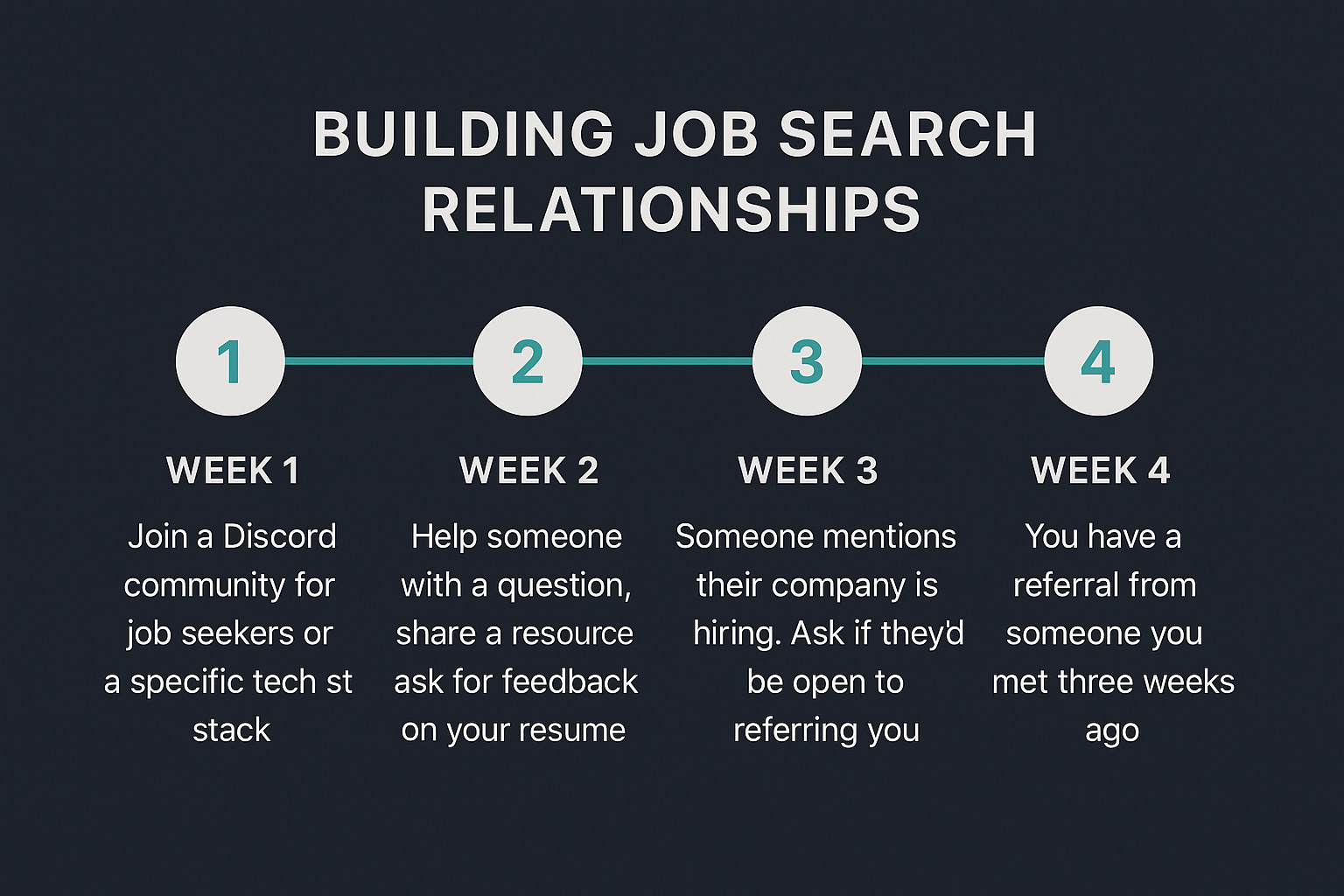
The timeline often looks something like this. Week 1, you join a Discord community for job seekers or a specific tech stack. Week 2, you help someone with a question, share a resource, ask for feedback on your resume. Week 3, someone mentions their company is hiring and you ask if they’d be open to referring you. Week 4, you have a referral from someone you met three weeks ago.
This happens in Blind, Discord servers like Reactiflux and Python Discord and Tech Career Growth, Twitter/X tech communities, local meetups, even LinkedIn comments. The key is being helpful and visible, not just asking for things.
Coffee chats work too, but be strategic. Don’t ask, “Can I pick your brain?” Instead, try “I’m applying to [Company] and saw you worked there. I have two specific questions about the interview process. Would you have 15 minutes this week?” Specific asks get responses.
Stop thinking of networking as something you need to have done already. Think of it as something you do while searching. Every application, every post about your projects, every community you join is building the network that might help you land the next role.
Visibility + Specificity > Volume.
Building something visible and applying strategically to 20 matched roles tends to outperform 200 spray-and-pray applications and waiting for your existing network to save you.
📺 Watch This to Land a Tech Job
This video covers the complete strategy for breaking in, from skills to applications to interviews. The patterns I’m seeing in my community align with the fundamentals here. Impact-driven resumes, leveraging referrals the right way, and preparing for both behavioral and technical interviews.
How did you land your job or your most recent interview? Reply and tell me. I’m curious what’s working right now.
Start Building
If you’re still working on coding fundamentals, check out Coddy. Bite-sized projects with an AI bot that answers your questions while you build. Start with their Python module, then move to Java and JavaScript.
It’s free to use. If you want premium features, use code SAJ20 for 20% off.
Your Turn
How did you land your last interview or job offer? Cold application, recruiter outreach, or a referral you built along the way?
Hit reply and let me know. I’m always looking for patterns.
— Sajjaad